


Three different electric vehicles I recently drove interested me more for their symbolism than for their substance. Two of them followed the dead-end direction electrics are currently traveling, and one took a more promising course. Therefore the three battery-driven transports symbolized the folly of the manic insistence by a few people that all other people drive electric, contrasted with the most probable niche that electric cars might eventually grow to fill.
The three electric models were the Ford F-150 Lightning pickup truck, the Volvo C40 Recharge station wagon, and another wagon, the Toyota bZ4X.* All were well designed, loaded with accessories, and satisfying to drive. Each exhibited the smooth and assuring power delivery that is characteristic of an electric vehicle.
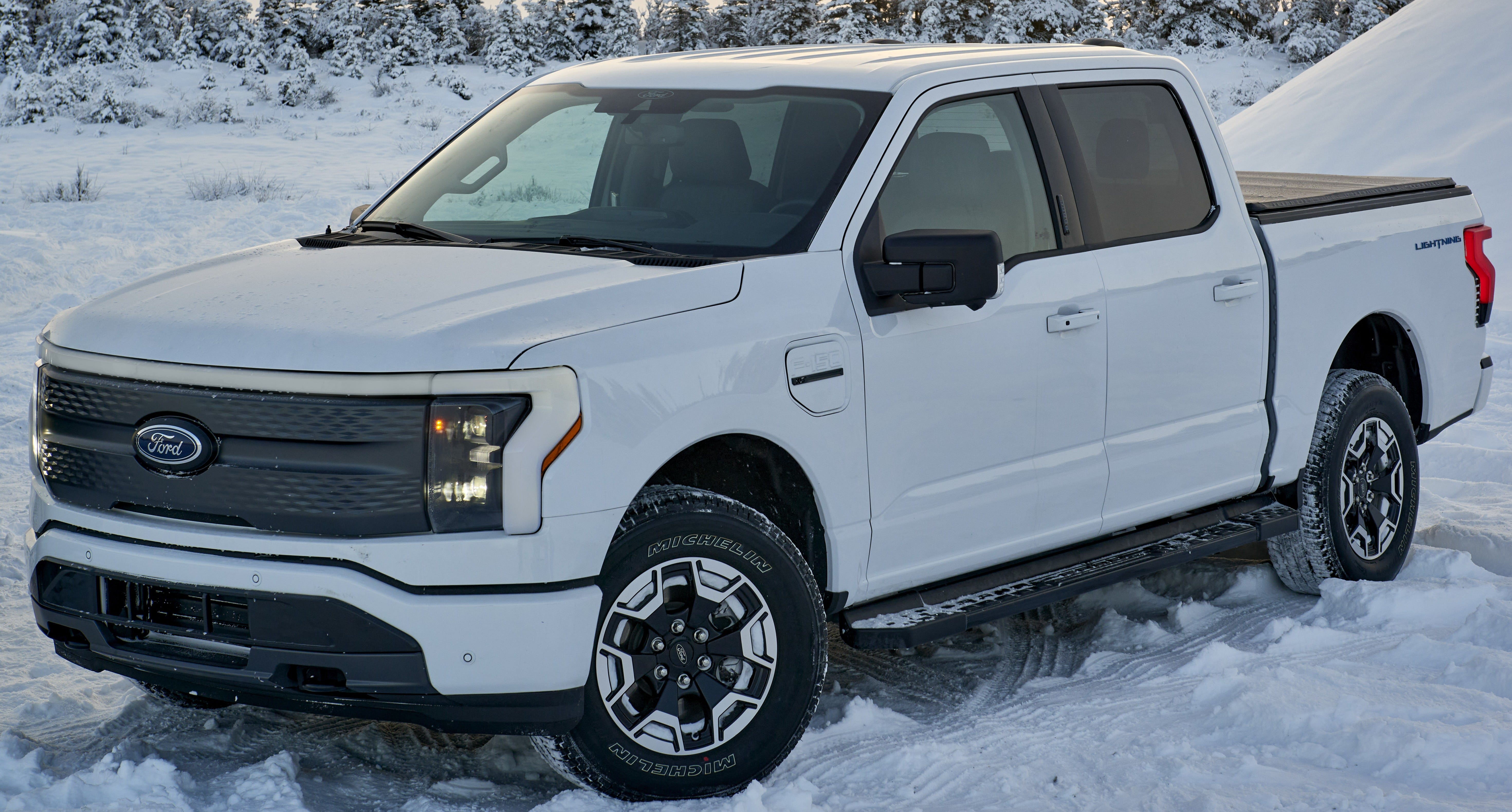
The Ford F-150 Lightning was the largest of the trio by far. With what Ford calls a SuperCrew cab that fits five people with extraordinary ease – wide seats, enormous leg wells, high ceiling – and a five-and-a-half-foot bed in back, it is about two feet longer than a basic gasoline-fueled Ford pickup. The Lightning has two electric motors, one in front and one in back, making the pickup four-wheel drive. Ford offers it only in the top half of trim levels available on its gas-powered trucks. The lowest priced version is the Lightning XLT, priced at $56,990. (All prices are for 2024.) That’s $1,045 higher than a gasoline-fueled F-150 XLT with four-wheel drive. At the top end, an F-150 Lightning Platinum Extended Range lists at $93,990. That’s $18,150 above a Platinum F-150 running on gasoline, although a buyer can drive the gas truck’s price closer by laying on options.
“Extended Range” refers to the larger of two batteries Ford offers in Lightning. It can move the truck for 320 miles under ideal conditions when it is fully charged, Ford advertises. The smaller, “standard range” battery can propel the pickup 240 miles in ideal conditions when fully charged. Depending on the type of charging station used, reaching that full charge can take as few as one or two hours, and as many as 19 hours.
Smaller and therefore much more maneuverable and manageable, the Volvo C40 Recharge** was just as luxurious as the mammoth Ford. As a luxury brand, Volvo builds an upper-crust aura into the C40 Recharge. In fact, it takes pains to appeal to the sensibilities of wealthy people, who can afford to exclude and discriminate against common taste, by publicizing that no animals are killed for the upholstery inside the C40, because the model does not offer leather seat coverings.
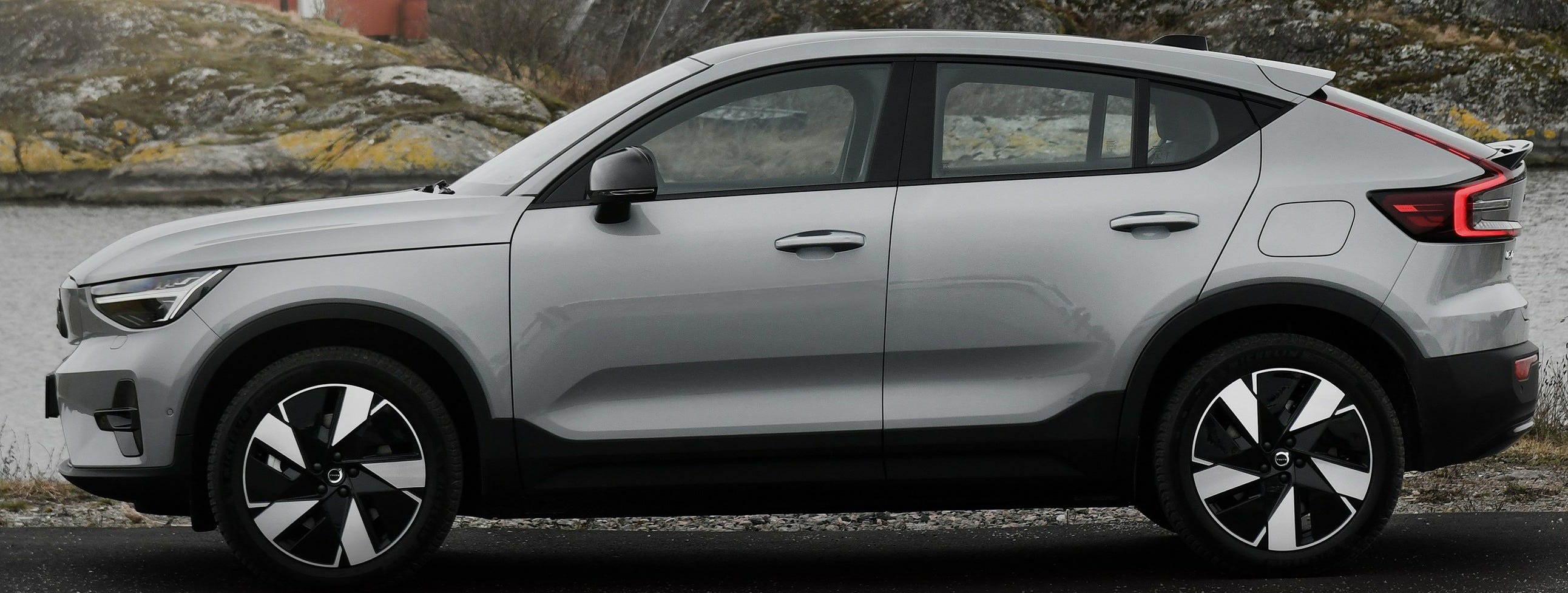
They’re not needed: The cabin of the C40 expresses luxury in other ways, as with its handsome, uncluttered design, and with details like the clear, faceted, gem-shaped knob of its gear selector. In addition, Volvo adds distinctive novelty with illuminated map-like images that are computer generated and appear on door and dashboard panels – a non-functional feature that makes the wagon stand above the ordinary.
The Volvo C40 starts at $54,895 for a rear-drive model. An additional $1,650 adds a second electric motor to turn the front wheels, making the car all-wheel drive for $56,545. In perfect circumstances, a rear-drive version can travel for 297 miles on a battery charge, while a four-wheel-drive C40 goes for 257 miles, Volvo advertises.
Beginning in 2025 a software change makes the C40 faster. Called Performance, the software option directs more of the car battery’s power to the electric motors, for speed bursts.
But making an electric car faster, and also luxurious, contradicts today’s manic, immediate demand that gasoline-fueled cars be replaced by electric trundlers. We’re in an energy emergency and facing catastrophe, we’re told. Cars are destroying the Earth’s climate, we’re told, creating an existential crisis – a threat to our very existence – and therefore a complete transportation change is needed. We’re told.
But in a dire energy emergency – one that threatens existence – all efforts would aim at conserving energy, at using less of it. Vehicles, even electric vehicles, use more energy when they’re made to go faster. Luxury products, with their many accessories and decorations, use more energy. So do enormous pickup trucks. Therefore battery-powered models like the Volvo C40 Recharge and Ford F-150 Lightning contradict the whole rationale for changing whole-scale to EVs. They approach the problem as if energy consumption is irrelevant, and that all we need to do is make a one-to-one replacement of electric vehicles for gas-powered ones, retaining today’s extreme levels of personal mobility.
And if there is no dire problem, if we’re not in an existential energy crisis that demands austerity, why should all of personal transportation be re-ordered immediately? Why are governments requiring it? Shouldn’t freely choosing people and the car makers that serve them have liberty to work out preferences on our own?
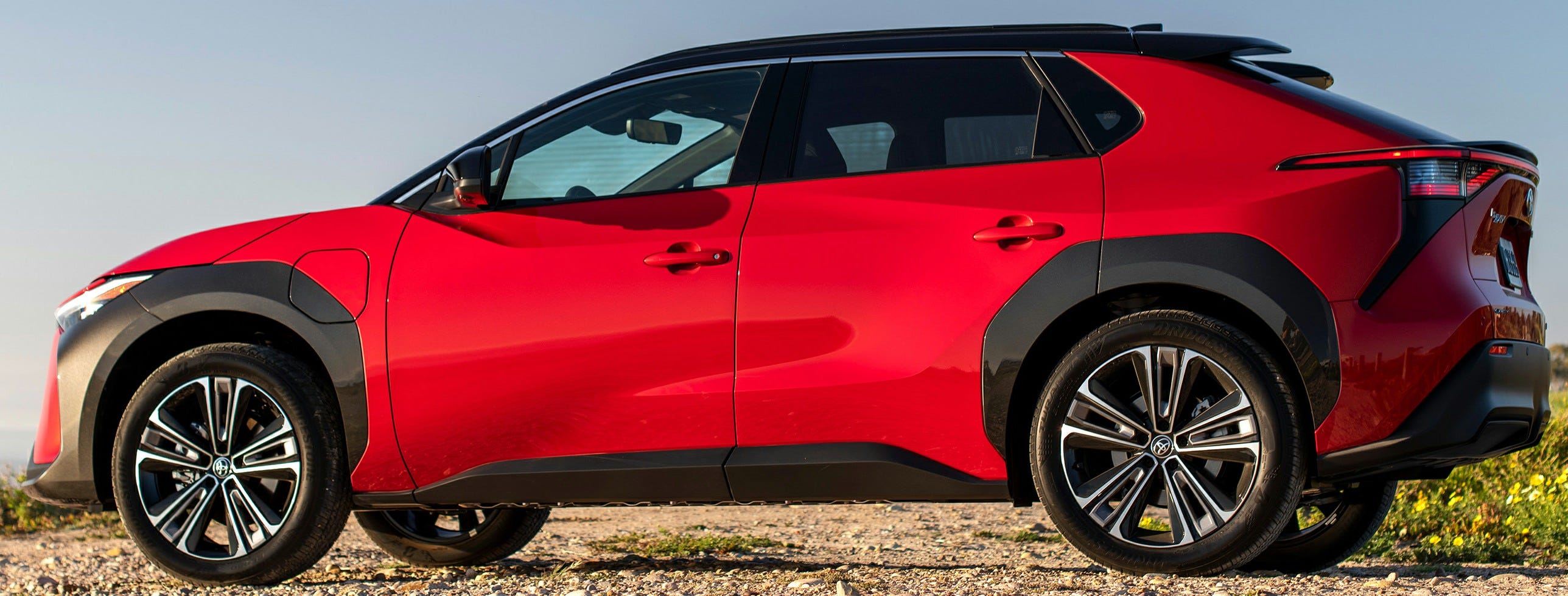
The Toyota bZ4X was the most practical of the three electric models I recently drove. Also, importantly, it was the most modest. Its design seems to recognize that battery-powered vehicles are something different, not necessarily one-to-one replacements for today’s popular personal transporters.
Rather than overreaching, the Toyota model leans toward practicality, which makes it seem more suitable for shorter jaunts, not the boisterous road coverage we undertake with conventional, gasoline-fueled cars. It has no glove box and it also lacks the additional storage that other EVs give you under the hood, where a gasoline-powered car would have its engine. Its cabin is cleanly designed, with the cell-phone aesthetic that is de rigueur with battery cars, but it is not overly adorned.
It doesn’t make a fetish of extending driving range, pretending that battery-powered cars can compete with the carefree mobility provided by gas-fueled models. Even so, the stated range of the bZ4X isn’t too far below the advertised ranges of the Lightning and C40. Toyota publishes a maximum distance of about 250 miles for front-drive versions and 225 miles for four-wheel-drive versions, under ideal conditions. But Toyota achieves that not by stuffing enormous batteries into large, showy, over-capable vehicles. Instead it extends battery range by making the car itself more lightweight , which electric vehicles must be to prevent them from too quickly sucking up fuel – battery power, in their case. Witness the extensive presence of lightweight plastic shaping the Toyota’s hammer-blunt nose.
The bZ4X provides about the same amount of cabin space as the Volvo C40 wagon, but it weighs 240 pounds less than the Volvo. It weighs 2,350 pounds less than the Ford Lightning. Accordingly, its battery is smaller. It gets by with 20 percent less electricity storage than the Volvo and 50 percent less than the Ford.
The bZ4X needs more than nine hours to fully charge when plugged into a high-voltage charger installed in its owner’s garage – the most likely re-charge scenario for a car of this character. Toyota gives bZ4X a starting price of $44,465.
In spirit, the bZ4X contrasts with the Ford electric pickup and Volvo’s energized wagon. Toyota treats its electric pup more as a distinct and separate entry in the auto market, whereas Ford and Volvo clone their approach to gas-powered cars. Except for the inherent differences in the feel of power delivery between gas and electric, the Lightning and C40 strive to be like popular gas models the companies sell. Ford even covers the nose of Lightning with a fake grille, mimicking the grilles that standard Ford pickups need to cool their gasoline engines.
In that way the Ford and Volvo symbolize the brash assumption of electric-car absolutists. Approaching the issue of fuel type, electricity over gasoline, with religious fervor, and with no deep concern for the easy mobility that people desire, they assume that switching entirely to electric cars is a simple one-to-one replacement issue. Require everyone to drive electric cars, they assert, and people can continue enjoying the effortless, affordable, and inviting mobility we currently experience with gas cars.
The idea is naive. It assumes that lifestyle creates a technology. In fact, a technology, through the abilities it brings to people, creates lifestyle. Our hyper-mobile lives today are a result of gasoline-powered cars. The cars didn’t come after someone decreed that people – all people – should freely move around with ease. The cars came first. Today we freely cover distance with ease because current motor vehicles brought us that ability.
Vehicles powered with electricity that is generated outside the vehicle and then piped in vast amounts to the vehicles at all the various places where we live and drive – and drive constantly, over so many carefree miles – are not one-for-one replacements for vehicles that carry fuel onboard and generate their own energy. Unless we see an astounding increase in electricity generation, and a stupendous increase in transmission lines to pipe that new electricity to everywhere, and a quantum leap in the speed at which big batteries can be recharged, our lifestyle of free and easy mobility would have to change to suit EV technology. Will people freely choose less mobility?
The Ford F-150 Lightning and Volvo C40 Recharge symbolize the one-for-one assumption. The Toyota bZ4X leans toward electric vehicles as separate technology, as possible additions to our current abilities. If people are left alone and not forced to buy EVs, the battery cars may develop into special-purpose scramblers to cover regular, predictable routes at close-to-home distances. Commutes for work, for instance, or runs to the grocer. For Kerouac-style, carefree and spontaneous road-going, given the choice, people will stick with petro-powered cars.
Americans don’t love cars. We love mobility. We’ll choose whatever technology gives us the most.***