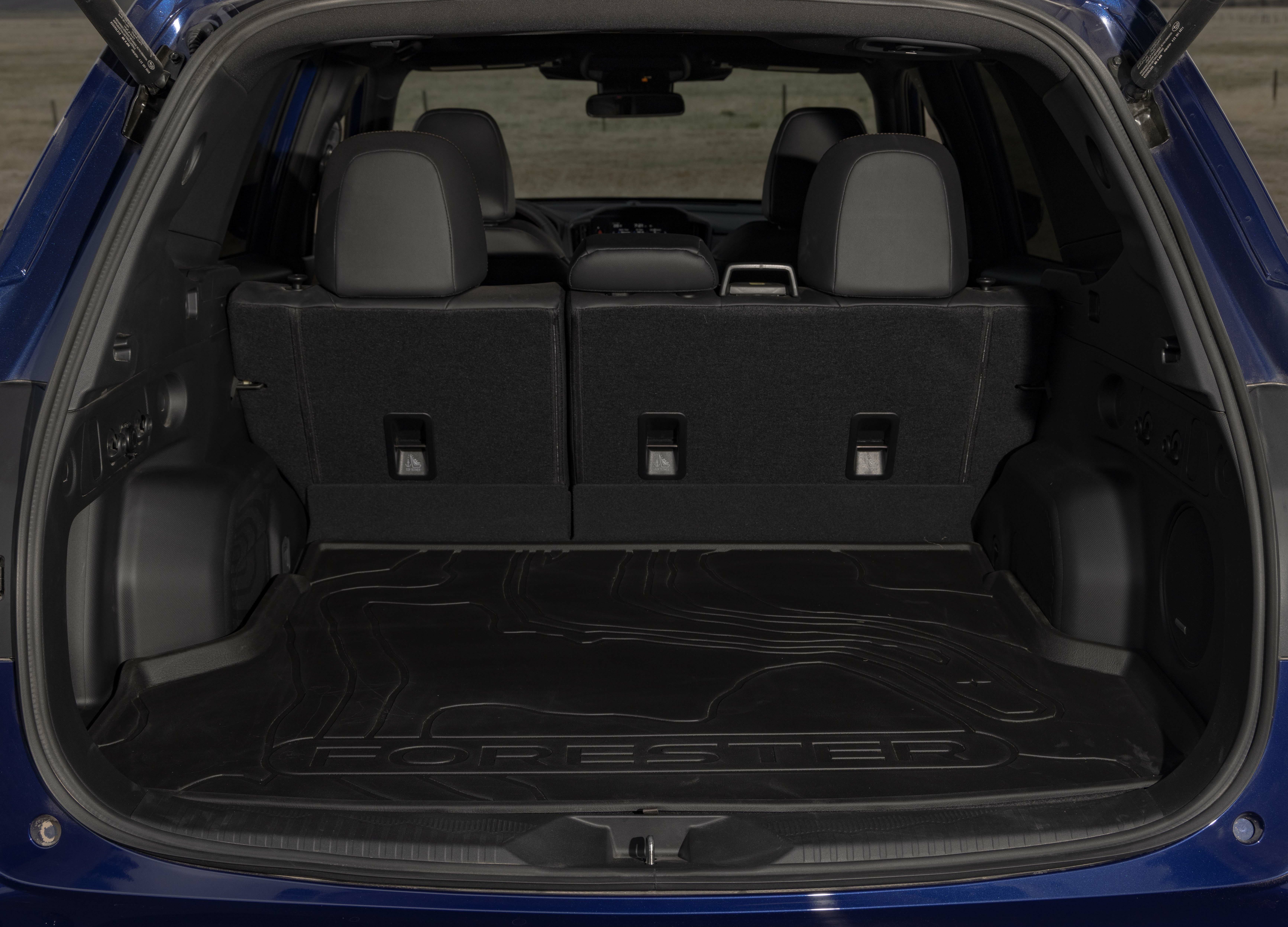
Subaru Forester
Distant storm clouds

Looking longer term, Subaru is in trouble. Its re-made Forester sport-utility vehicle tells why.
To me the Forester has long been the Subaru model that is most emblematic of the company’s character. It’s like an unpretentious plain-Jane sister who adores her family and embraces the role of ever-ready helpmate. She’ll carry you on her back if you tell her you’re weary.
The Forester is a basic, practical, get-’er-done transporter. Its attitude expresses Subaru’s customary approach to motoring: Yeah, we’ll get you there. That’s why the company historically has specialized in four-wheel-drive motor cars. In certain conditions, especially in snow and on ice, you need engine power at all four wheels to get you there.
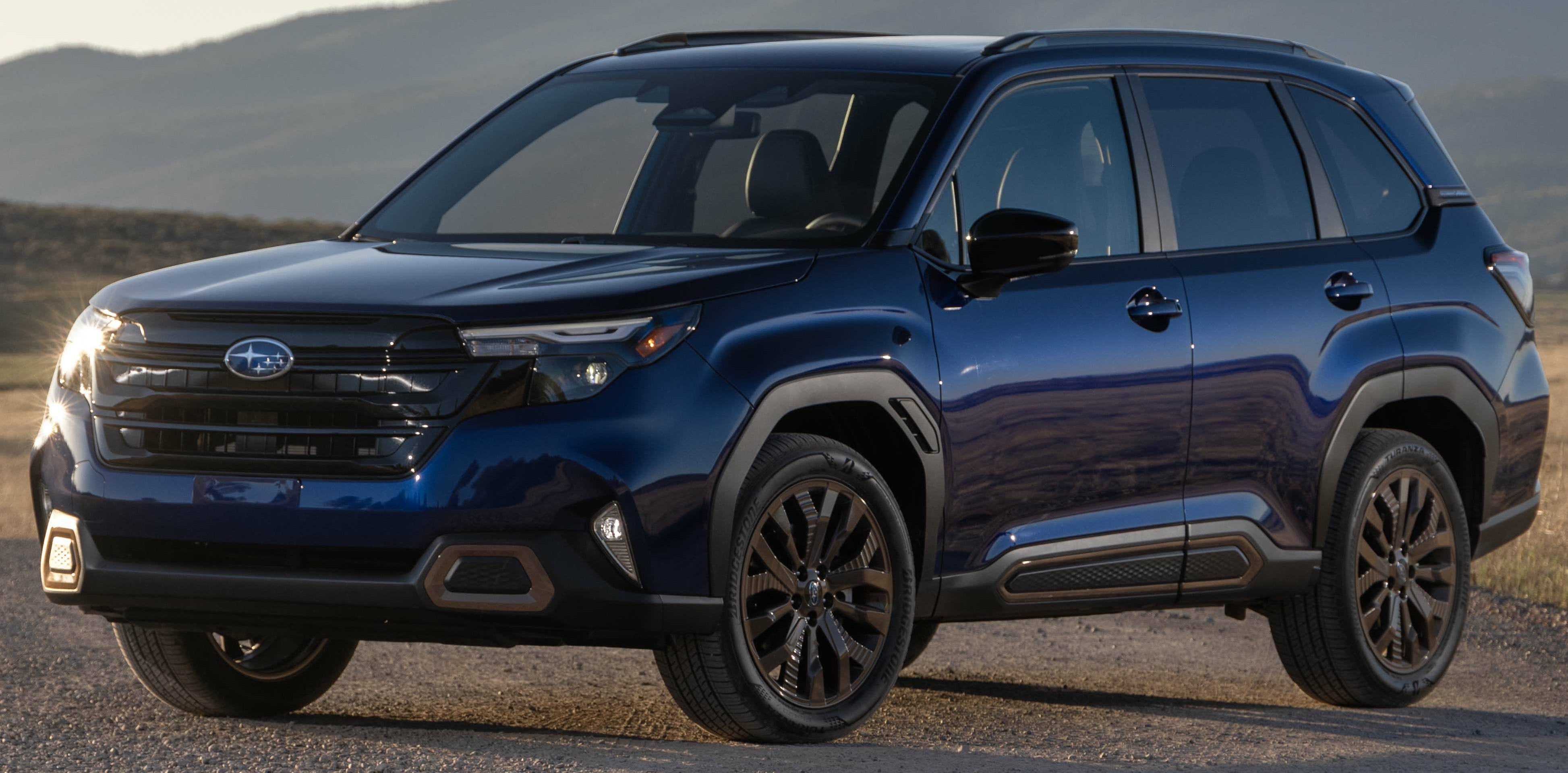
Today’s Forester departs substantially from early versions, which were small, square-edged, high-roofed station wagons equipped with four-corner traction that made them elementary SUVs. Today the Forester, officially classified as a middle-sized sport-utility, is substantially larger than those ancestors.
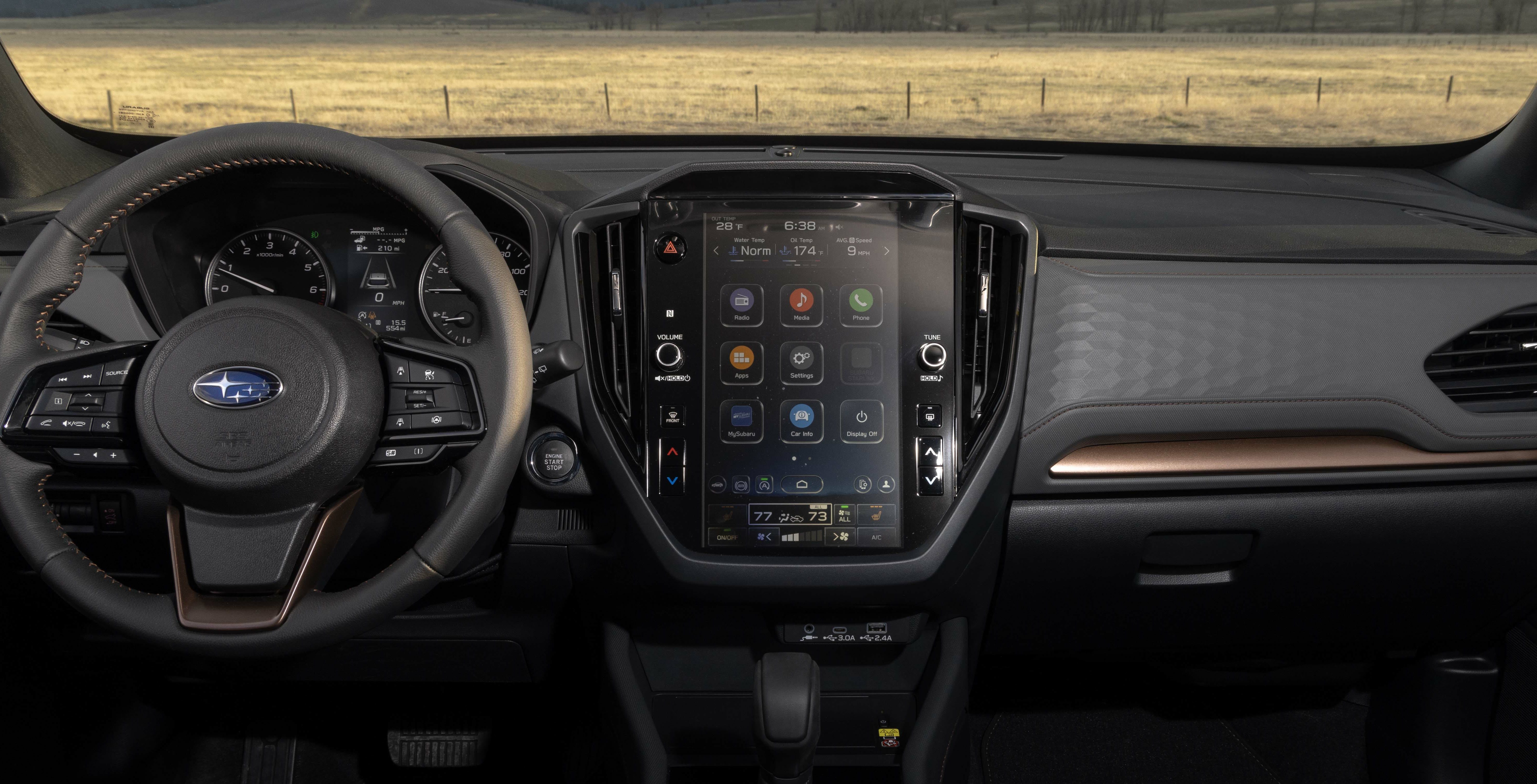
Subaru began selling a modernized, fully re-engineered and updated Forester in 2024. The new model is nicely shaped, with curves and chamfers that keep it from looking awkwardly angular and boxy. But at the same time it doesn’t attempt to hide its upright, two-box SUV identity. (A smaller box for engine, in front of a larger rear box for people and things.) Its inside is cleanly functional, with gauges and controls laid out logically, and seats and panels covered with durable materials showing easy-clean matte lusters. The new model’s back seat is inviting in a serious, sensible way. Its rear opening gapes conspicuously wide for easier loading – practical.
Thus the re-made model retains the long-standing Forester attitude as a no-nonsense, practical hauler. But it also shows how changes in today’s auto world point toward Subaru’s undoing.
Subaru vehicles are popular in snowy regions because the company’s four-wheel-drive systems stand out. Subaru has been an engineering-driven company that builds cars around what engineers said works best, rather than telling engineers to fit something that works inside pretty shapes. Therefore Subaru models historically lagged in eye-pleasing design and people-pleasing comfort. But, darn, they sure stayed on the road, no matter how slippery that road may have been.
But today four-wheel power is commonplace and is sold as an option on many models, not just sport-utilities but a lot of traditionally configured sedans and small station wagons too. That erases Subaru’s edge. Yes, the company’s cars provide better winter grip than most other all-wheel-drive vehicles. But that won’t matter in the broad auto market, where people buy all-wheel drive for peace of mind and never really put it to the test. Today’s widespread availability of four-corner traction from other car companies will make Subarus increasingly harder to sell.
To survive, the company needs a new way to distinguish itself.
It should stick to its roots as an engineering-driven automaker, making cars that stand out as superlative machines – even if they lag, as Subarus always have, in the niceties of style and numbing comfort.
Subaru shows some signs of attempting that. It has jumped aggressively into computerized automatic safety equipment that controls driving. Marketed as its EyeSight family of driving aids, the devices includes the usual collection of invisible assistants, such as lane following and correction, traffic-sensitive speed control, obstacle detection and automatic braking. In Forester, EyeSight abilities are included in the model’s full lineup, from its least expensive version, at $28,190, to its most expensive, at $38,490 (2025 prices).
But by trying to attain an engineering edge with EyeSight, Subaru is trying too hard. I’ve felt like I’m wrestling with the auto to assert control at times when a new Subaru has tried, for instance, to automatically reposition the car in a freeway lane. It’s over-zealous.
Also, as automatic driving aids become more commonplace in all cars, emphasizing them isn’t a promising way to assert a separate identity. Like all-wheel drive, the abilities now are turning up everywhere.
A better long-term survival strategy for Subaru is to return to distinction in mechanical hardware that translates to unique and satisfying driving – the way its four-wheel power distribution has traditionally done. That will attract and hold people who enjoy driving. We’re not a large enough population to support, say, a car maker the size of Toyota. But Subaru never had ambitions to be as large as Toyota. It doesn’t need to move beyond its middle-tier size among car companies to remain successful – and therefore remain alive in the longer term.
Unfortunately, at the moment Subaru is moving in the opposite direction. For example, it is getting close to abandoning manual, shift-it-yourself transmission options in its models. You can’t get one in the new Forester, for example.
Worse, Subaru is walking away from geared automatic transmissions. Instead, as in the new Forester, it installs continuously variable transmissions – belt-and-pulley devices akin to the transmissions in snowmobiles. They can improve fuel economy. But they’re less satisfying to drive than geared automatics or geared manuals– especially in cold-weather regions where Subaru has a following due to its earlier prowess in four-corner traction.
It’s a money-saving measure. Continuously variable transmissions (CVTs) are cheaper to manufacture, because they don’t require all the forging and machining of gears. Thus CVTs boost Subaru’s profit. But so what if they eventually diminish Subaru in its followers’ eyes?
A company’s downfall is most often slow and initially imperceptible. After all, the principle of momentum also applies to human organizations: Their motion grinds down slowly. But on the evidence of the new Subaru Forester, emblematic of Subarus character and a fine vehicle in the ways described here, the decline is underway. Let’s hope Subaru reverses it.
For a different perspective on the Subaru Forester, see a separate Car Sense review in the 20-year-old Driver section. Read it here.