


The battery-powered Ford Mustang Mach-E hatched wagon tries to move electric cars forward in two ways. It also points to two big problems bedeviling the Ford Motor Company.
One of Mach-E’s positive moves is making the price of an electric vehicle (EV) more approachable. Ford prices the medium-sized wagon at $38,490, rising to $57,790 for versions with added features. That’s still high compared to some similarly sized wagons with conventional engines fueled by gasoline. The Kia Seltos starts at $25,995, which is 32 percent lower than the Mach-E. The Nissan Kicks opens at $23,220, or 40 percent less. The Chevrolet Trax, at $21,495, is 44 percent less.* (2025 prices) Compared to those examples, the Mustang Mach-E does nothing to keep autos affordable and accessible to people with lower incomes. But compared to some other battery-powered movers, and ignoring gasoline-fueled vehicles, the Mach-E appeals in price.
Its more straightforward, unfrilled character is the second asset Mustang Mach-E brings to electrics. Rather than brazenly announcing itself with a rocket-ship exterior shape and eye-grabbing interior gimmicks, the wagon makes a more prosy statement: Just get in and go someplace.
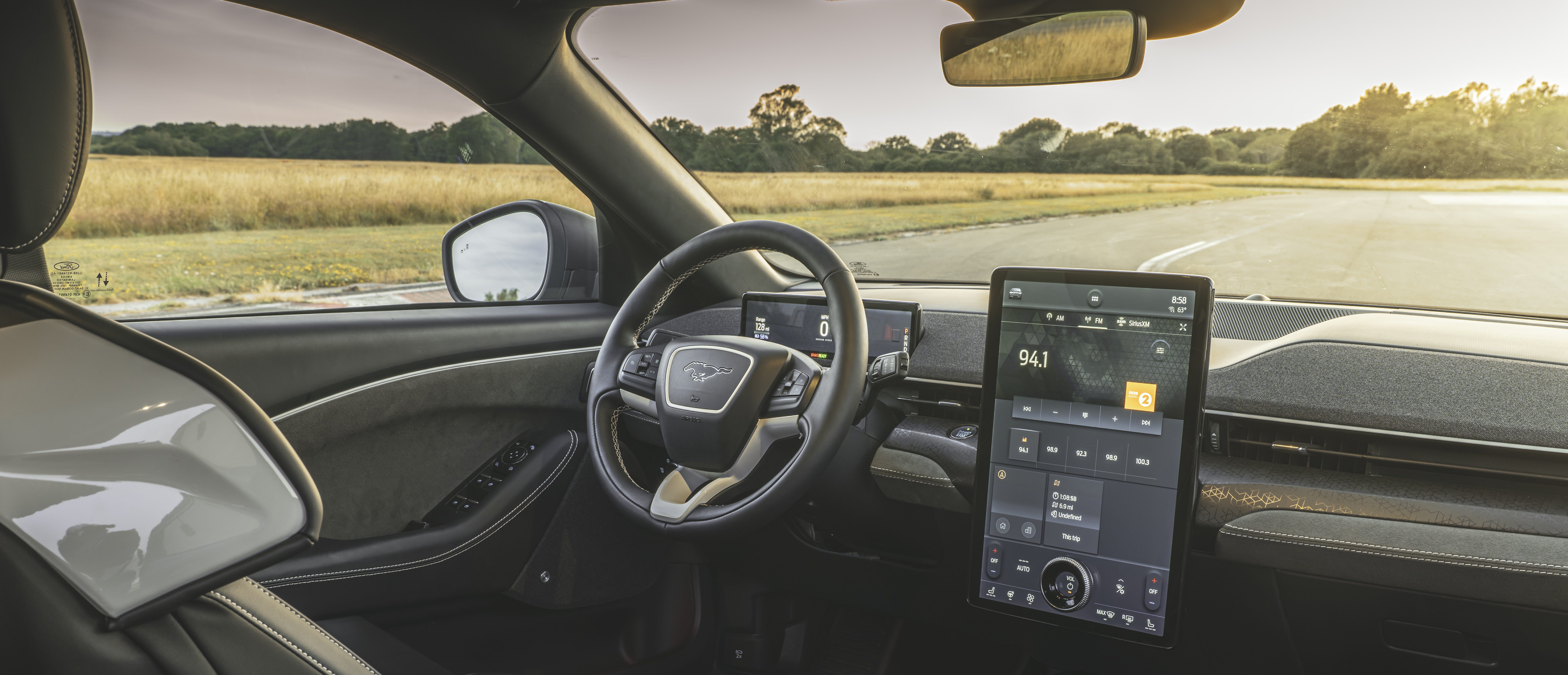
The Mach-E’s cabin is comfortable front and back, and well sized for four people. It is cleanly designed and on the whole neutral. It doesn’t go overboard with the cell-phone aesthetic adopted by most other electrics. Instead its insides appear traditional – not old fashioned, but with the look and feel that traditional, evolutionary car design has delivered today.
(Read a Car Sense Tech Topics comment about the big touchscreen in the Mach-E here.)
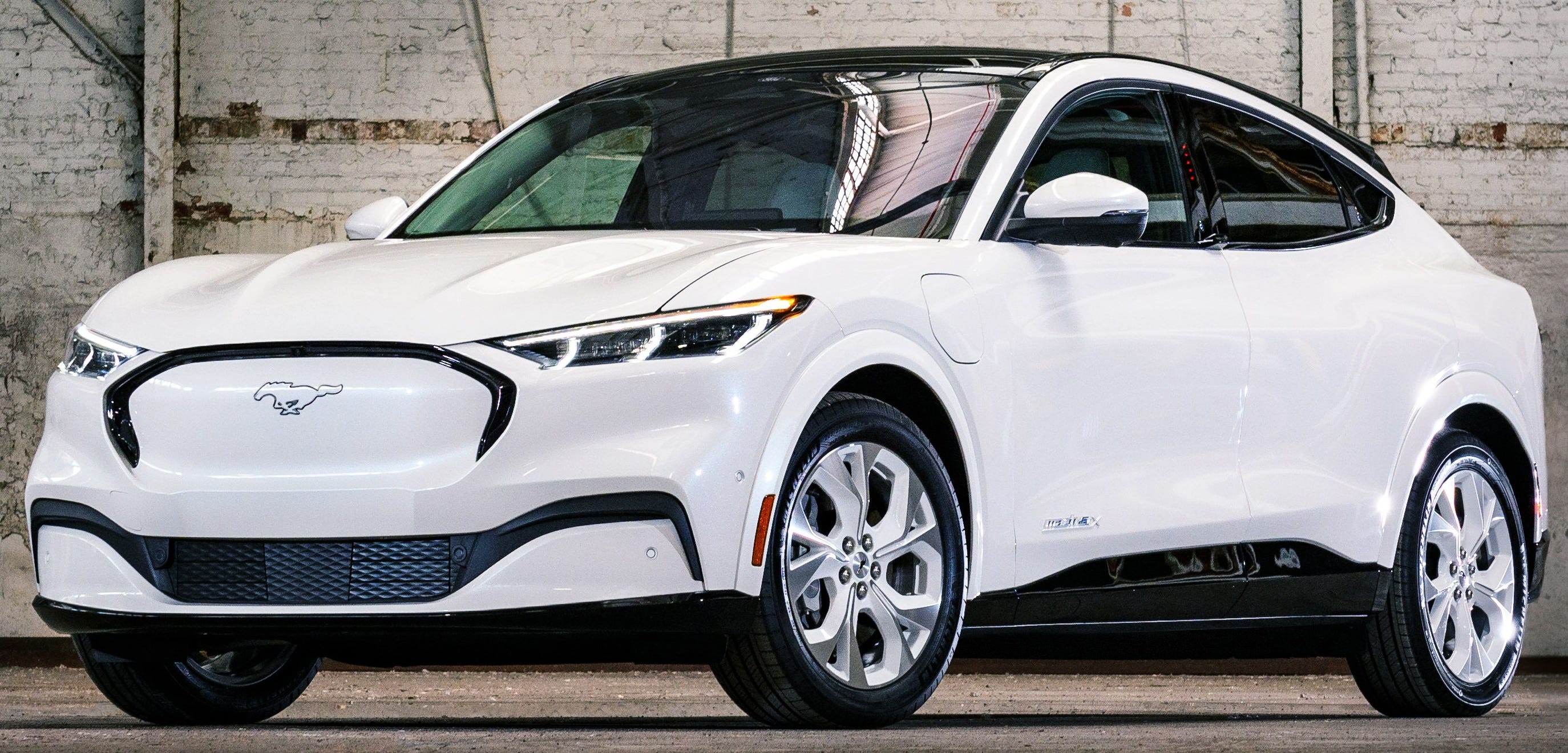
The Mach-E’s outside attitude shows the same evolutionary influence as its inside. Fashioned as a wagon with a contiguous cabin ending at a back hatch, the car strains to convey the muscle-car image attached to Ford’s original Mustang two-plus-two sports car that is gasoline fueled. The battery-powered Mach-E has an upright, blunt front and long hood. It sits back on haunches, creating a profile that looks like a springing crouch.
A simulated grille is attached to its nose. A real grille is unnecessary, because battery cars don’t need to take in air to cool an internal-combustion engine. Additionally, a tall longitudinal bulge rises above the hood of Mustang Mach-E, sided by two pointy longitudinal strakes. They are features that advertise power in a gasoline car, because they make more room underneath the hood for a big engine. In an EV like Mach-E, they are unneeded and irrelevant.
The Mach-E has loads of zip and can be engaging to drive. But its muscle-car imitations show that Ford once again falls for the one-to-one fallacy regarding electric and gasoline cars.** That’s the first big problem for Ford exhibited in the Mach-E. The electric Mustang is trying to appeal to muscle-car enthusiasts the same way the established gas-hog Mustang does. But battery cars are not one-to-one replacements for get-in-and-go – and keep going – gasoline vehicles.
During a week of driving, I plugged in a Mustang Mach-E 4X GT two times for recharging. I used public Level 2 charging stations. Level 2 stanchions are the most common public charging stations, with recharge speeds about equivalent to a dedicated car charging station installed in a homeowner’s garage. With the Mach-E’s gauges indicating a 37 percent battery charge and 78 miles of driving range, I plugged in the wagon for four and a half hours. Its battery state came up to 68 percent charge, with a range of 182 miles. That’s 31 percent more battery juice and 104 miles of driving added after four-point-five hours.
Later, with 26 percent charge and 57 miles of driving range, I plugged in for nine hours. The battery state came up to 88 percent charged, with 223 miles of motoring range. That was 62 percent more battery power and 166 miles of driving distance added after nine hours of plug time.
It simply takes much longer to saturate a battery with electricity than to fill a hollow vessel with liquid. That limits battery cars to a secondary role in our hyper-mobile culture. Therefore electric models should be small, lightweight and low priced, to match the close-to-home, regular-route or stand-by role that battery cars might conceivably fill.***
Ford can’t go small, light and cheap with models it manufactures in the United States, because it pays Ford employees so much, all through the ranks, from top executives to factory workers. And also because it must satisfy government rules that make manufacturing difficult and expensive in America. Its resulting high costs to manufacture here limits Ford to making only larger, more expensive vehicles that it can charge higher prices for. For lower priced vehicles, it has to pay factory workers in other countries to make them, and ship them here.
With battery cars, that puts Ford in a bind. The limitations of electrics makes them most widely appealing when they are inexpensive. The Mach-E, as I noted at the start, doesn’t go low enough in price, even though Ford makes the model in Mexico and China, not in the United States.
But with Mustang Mach-E, Ford at least makes a gallant effort to reconcile the limitations of electric vehicles with the patterns of American personal mobility.